 NewsMakers-Daily Latest Urdu Breaking News Updates We Make Better News
Web Desk
April 23, 2026
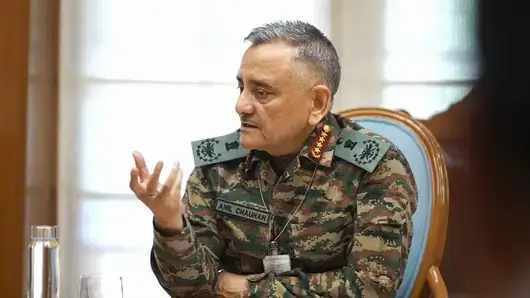
India’s Chief of Defence Staff (CDS), General Anil Chauhan, has sparked a fresh debate over “Operation Sindoor” — India’s May 2025 military action against Pakistan — with recent remarks that analysts are interpreting as an indirect acknowledgment of operational setbacks.
Speaking at a public event, General Chauhan urged the armed forces to look beyond past experiences and focus on future preparedness.
“The challenges ahead will be different; we need to move past the previous ‘Sindoor’ and prepare for the next,” he stated.
Observers noted that his cautious tone and reflective delivery suggested an effort to manage internal morale while addressing operational shortcomings .
Emphasis on Technology and Coordination
During his address, General Chauhan placed significant emphasis on the role of emerging technologies in modern warfare, describing technological advancement as a critical factor for future readiness. He also stressed the need to improve coordination among India’s three armed forces — the Army, Navy, and Air Force.
However, defense analysts have expressed reservations about these explanations.
“Technology alone cannot compensate for gaps in strategy, coordination, and professional execution,” one analyst noted.
‘Move Past the Previous Sindoor’
The phrase “move past the previous Sindoor” has drawn particular attention. Some experts argue that referring to a “next Sindoor” indicates an attempt to shift focus away from past difficulties rather than directly addressing them.
Defense observers point out that poor coordination among India’s tri-services has been a longstanding challenge. General Chauhan’s emphasis on improving coordination is seen by some as an indirect admission that this lack of synergy contributed to operational difficulties.
Official Position
General Chauhan has previously acknowledged unspecified aircraft losses during the initial phase of Operation Sindoor. In May 2025, he stated:
“I think what is important is not the jet being downed but why they were being downed,” he told Bloomberg TV.
He dismissed Pakistan’s claim of shooting down six Indian jets as “absolutely incorrect”.
However, General Chauhan has also claimed that India achieved its objectives. In June 2025, he stated that Pakistan’s planned 48-hour offensive “folded up in about eight hours” and that Pakistan requested talks to end hostilities.
Pakistan’s Perspective
Pakistan’s military and political leadership has consistently maintained that Operation Sindoor ended in a strategic defeat for India. According to the Inter-Services Public Relations (ISPR), Pakistan’s air defense systems successfully neutralized Indian incursions, and Indian aircraft were forced to retreat after suffering losses.
International analysts note that the operation highlighted the effectiveness of Pakistan’s integrated air defense systems, which combined legacy systems with real-time command networks to neutralize incoming threats.
Political Repercussions
The debate over Operation Sindoor has also triggered political tensions within India. The Congress party has reminded the public that General Chauhan had acknowledged the downing of Indian aircraft during the operation and questioned why the government refused to call a special parliamentary session to discuss this critical national security issue.
Some analysts suggest that the widening gap between military leadership and political authority reveals “serious internal contradictions in India’s governance”.
2 Pakistani Astronauts Selected for Chinese Space Mission
Looking Ahead
General Chauhan’s remarks suggest that the Indian military is engaged in a reassessment of its operational strategies. Whether this amounts to an acknowledgment of defeat or simply a pragmatic focus on future readiness remains a matter of interpretation.
“The remarks show India has lessons to learn from past operations and must focus on improving coordination and strategy for the future,” analysts concluded.