 NewsMakers-Daily Latest Urdu Breaking News Updates We Make Better News
Web Desk
April 21, 2026
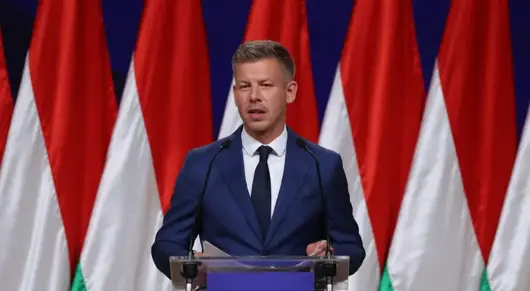
BUDAPEST – Hungary’s newly elected Prime Minister Peter Magyar has declared that his government will detain any leader wanted by the International Criminal Court (ICC) — including Israeli Prime Minister Benjamin Netanyahu — should they set foot on Hungarian soil.
The statement marks a dramatic reversal of his predecessor Viktor Orban’s policy and has created a diplomatic dilemma just months after Netanyahu accepted an invitation to visit Budapest.
‘Must Be Taken Into Custody’
Responding to a reporter’s question about whether Netanyahu would be arrested if he visits Hungary, Magyar gave a clear and direct answer.
“If someone is a member of the International Criminal Court and a person who is wanted enters our territory, then they must be taken into custody,” Magyar told reporters at a press conference on Monday.
The incoming prime minister added: “I don’t need to spell everything out over the phone. I assume that every head of state and government is familiar with these laws”.
Halting Hungary’s ICC Withdrawal
Magyar also confirmed that his government will halt Hungary’s withdrawal from the ICC — a process initiated by former Prime Minister Viktor Orban following Netanyahu’s visit to Budapest in April 2025.
The withdrawal was scheduled to take effect on June 2, 2026. However, Magyar stated that his government can stop the process before Hungary formally leaves the court.
The previous Orban government had rejected the ICC warrants, describing the court as “politically biased” and guaranteeing that Netanyahu would not be arrested during his visit.
The Netanyahu Invitation
The clarification came after Magyar had extended an invitation to Netanyahu to attend the 70th anniversary celebrations of Hungary’s 1956 anti-Soviet uprising in Budapest this October.
According to an Israeli readout of a phone call between the two leaders on April 15, Netanyahu had accepted the invitation . Magyar said he had made Hungary’s position on ICC membership clear to the Israeli prime minister during their conversation.
“I also made clear to the Israeli prime minister that we will not back down [from cancelling the ICC withdrawal] because my colleagues have examined it and we can still stop the withdrawal,” he said.
Background: The ICC Warrant
The International Criminal Court issued arrest warrants for Benjamin Netanyahu and former defense minister Yoav Gallant in November 2024.
The warrants allege war crimes and crimes against humanity — including starvation as a method of warfare — during Israel’s military campaign against Hamas in Gaza.
The ICC has no enforcement methods of its own and relies on the cooperation of its 124 member states to carry out arrest warrants.
What Other Countries Have Done
Since the warrants were issued, countries have taken different positions:
| Position | Countries |
|---|---|
| Would arrest Netanyahu | Belgium, Canada, Denmark, Finland, Ireland, Italy, Netherlands, New Zealand, Norway, Portugal, Spain, South Africa |
| Would not arrest Netanyahu | Argentina, Czech Republic, Romania, Poland |
| Claimed immunity | France, Italy |
Orban vs. Magyar: A Foreign Policy Shift
The policy reversal represents a fundamental shift in Hungary’s foreign policy orientation:
- Viktor Orban (outgoing): Close ally of Netanyahu, rejected ICC warrants, announced ICC withdrawal, guaranteed Netanyahu’s safety in Hungary
- Peter Magyar (incoming): Pro-EU conservative, will halt ICC withdrawal, will enforce ICC arrest warrants
Magyar has also made clear his intention to strengthen ties with the European Union, reversing Orban’s confrontational approach to Brussels.
Iran will not leave Strait of Hormuz: Mohsen Rezai
A Diplomatic Dilemma
The situation now creates an awkward diplomatic predicament. Netanyahu has already accepted the invitation to the October ceremony in Budapest . However, if Hungary remains an ICC member by that time, Magyar’s statement suggests Netanyahu would face arrest upon arrival.
Some analysts suggest the Israeli prime minister may choose to cancel or postpone the visit to avoid the legal risk. Others question whether the new Hungarian government would actually enforce the warrant against a sitting head of government of a friendly nation.
International Reaction
The United States has previously imposed sanctions on top ICC judges and prosecutors over the warrants for Netanyahu, with the UN criticizing those sanctions as “reprisals” . It remains unclear how Washington might respond to Hungary’s position.