 NewsMakers-Daily Latest Urdu Breaking News Updates We Make Better News
Sunday, 22 March 2026 | Web Desk
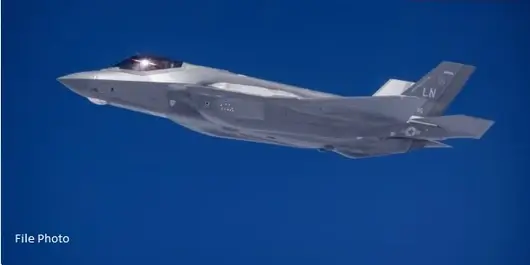
While reports indicate that the United States has lost approximately 16 fighter aircrafts in the ongoing war with Iran, the recent downing of a fifth-generation F-35 stealth fighter has sent shockwaves through military circles worldwide. The multi-million dollar aircraft, designed to evade radar detection, was successfully targeted by the Iranian forces. The Chinese aviation experts believe they have uncovered how.
The question has puzzled military analysts globally: How did Iran detect and target an aircraft built specifically to remain invisible to radar?
Iran just released footage reportedly showing one of its air defense systems successfully hitting an American F-35. pic.twitter.com/lWxzJsw5PN
— OSINTtechnical (@Osinttechnical) March 19, 2026
Infrared Sensors: The Achilles’ Heel
According to Chinese military experts, Iran may have bypassed the F-35’s renowned stealth capabilities by using electro-optical infrared sensor system rather than traditional radar.
Colonel Yue Gang (r) of the People’s Liberation Army explained that while the F-35 excels at deceiving radar, its stealth capabilities may prove vulnerable to infrared sensors.
“Although the F-35 is an expert at fooling radar, its stealth capabilities can falter against infrared sensors,” Yue stated. Infrared sensors track the heat signatures emitted by an aircraft, something that the most advanced stealth fighter is unable to conceal completely.
‘Death That the F-35 Cannot Detect’
Military expert Song Zhongping elaborated on why this method is particularly effective against stealth aircraft:
“Electro-optical/infrared sensors do not emit any electromagnetic waves. Because of this, the F-35 has no way of knowing that death is behind it.”
Traditional radar systems actively emit signals that can be detected, alerting the target to their presence. Passive infrared sensors, by contrast, simply receive thermal data without revealing their location or activity.
Cost-Effective Technology
Rather than deploying expensive air defense systems like the Russian-made S-300, which Iran also possesses, experts believe Iranian forces may have used infrared-guided missiles.
According to analysts, if an S-300 system had been used, the American aircraft could have been completely destroyed in mid-air. Instead, a lighter, less lethal infrared missile may have caused partial damage, allowing the aircraft to make an emergency landing—but the tactical achievement remains significant.
The R-27T Missile: A Decades-Old Solution
Media reports suggest that Iran may have used a modified version of the Russian-made R-27T air-to-air missile, which Tehran acquired from Russia in the 1990s alongside MiG-29 aircraft.
The R-27T has a diameter of approximately 0.23 meters and, despite its relatively modest power, can reach speed up to five times the speed of sound—exceeding the capabilities of several stealth aircraft.
Implications for Modern Warfare
The successful targeting of an F-35 using relatively older infrared technology has profound implications for modern air warfare. It suggests that even the most advanced stealth aircraft may have vulnerabilities that can be exploited with creative tactics and appropriate sensors.
For the United States, the incident raises questions about the invincibility of its prized fifth-generation fighter fleet. For adversaries and allies alike, it demonstrates that technological superiority on paper does not always translate to battlefield dominance when countered by thoughtful, adaptive strategies.
Unconfirmed Reports
While Chinese experts have offered a plausible technical explanation, the exact details of the engagement remain classified. Neither the US Department of Defense nor Iranian military officials have released official statements detailing the precise circumstances of the F-35’s damage.
What is clear, however, is that the incident has reshaped calculations about air power in the 21st century, proving that even the most advanced aircraft can be brought down by determined adversaries using the right tools and tactics.