 NewsMakers-Daily Latest Urdu Breaking News Updates We Make Better News

Web Desk: In a strong and swift response to India’s unprovoked missile strikes on Pakistani territory, the Pakistan Armed Forces have shot down five Indian Air Force (IAF) fighter jets, including three Rafales, one Su-30MKI, and one MiG-29, and a combat drone, while also destroying key Indian military infrastructure along the Line of Control (LoC), including a brigade headquarters and multiple checkposts.
The Indian strikes, carried out in the early hours of Wednesday, targeted six locations in Punjab and Azad Jammu and Kashmir (AJK), resulting in the deaths of 26 civilians, including women and children, and injuring at least 46 others, according to Pakistan’s military spokesperson Lt Gen Ahmed Sharif Chaudhry.
Pakistan’s Decisive Counterstrike
Speaking at a press conference, ISPR Director-General Lt Gen Chaudhry confirmed that all Pakistan Air Force (PAF) jets returned safely after successfully intercepting Indian aircraft. He added that Pakistani forces continue to retaliate forcefully along the LoC, inflicting heavy casualties and damage on Indian military positions.
Security sources also reported the destruction of multiple Indian army posts, with Indian troops abandoning nearly 90 border outposts amid sustained artillery fire from Pakistan.
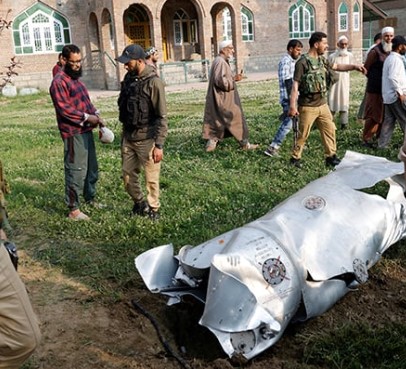
Metal debris lies on ground in Occupied Kashmir
Civilian Casualties from Indian Missile Strikes
Indian strikes hit several civilian areas, including:
- Ahmedpur East (Masjid Subhanullah): 13 martyred, including two toddlers and seven women; 37 injured
- Muzaffarabad (Masjid Bilal): 3 killed; a girl and a boy injured
- Kotli (Masjid Abbas): Two teenagers martyred; mother and child injured
- Muridke (Masjid Ummul Qura): 3 men martyred
- Sialkot and Shakargarh: Minimal structural damage reported
The Noseri Dam, part of the Neelum-Jhelum Hydropower Project, also suffered damage during the Indian onslaught.
International Reactions
- U.S. President Donald Trump described the escalation as “a shame,” urging both sides to restrain.
- China expressed regret over India’s unilateral action and urged de-escalation.
- UN Secretary-General António Guterres expressed “deep concern” and called for maximum restraint by both nuclear-armed nations.
Pakistani Leadership Responds
Prime Minister Shehbaz Sharif called India’s actions a “cowardly attack” and vowed a decisive response, stating, “Pakistan reserves the absolute right to defend its sovereignty.”
Defense Minister Khawaja Asif confirmed the downing of the Indian jets and emphasized that Pakistan’s retaliatory action had turned the tide in its favor.
Deputy Prime Minister and Foreign Minister Ishaq Dar condemned the attacks as a blatant violation of international law, asserting that the Indian Air Force targeted civilians using standoff weapons while remaining inside Indian airspace.
Pakistan’s Communication with the UN
Pakistan has formally apprised the United Nations Security Council (UNSC) of the evolving security situation and termed India’s actions as an “unprovoked act of war.” Islamabad reiterated its right to respond under Article 51 of the UN Charter.
Airspace Temporarily Closed, Now Reopened
Pakistan temporarily closed the airspace over Lahore and Karachi due to heightened military operations, but it was reopened after 8 hours. Authorities advised passengers to check with airlines for updated flight schedules.
Background: Rising India-Pakistan Tensions
Tensions have soared since the April 22 attack in Pahalgam, where over two dozen Indian tourists were killed. India immediately blamed Pakistan, despite failing to provide any evidence. In retaliation, India suspended several diplomatic and bilateral agreements, including the Indus Waters Treaty.
Islamabad denied involvement and offered to participate in a transparent international investigation, warning earlier that credible intelligence indicated imminent Indian military action.
Stay tuned for further updates as the situation unfolds.