 NewsMakers-Daily Latest Urdu Breaking News Updates We Make Better News
Friday, 13 March 2026 | Web Desk
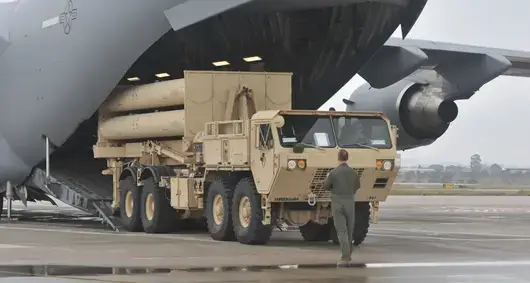
The United States has transferred its advanced Terminal High-Altitude Area Defense (THAAD) missile defense system from South Korea to Israel, as the ongoing war with Iran enters its 12th day and places increasing strain on American military resources in the region .
South Korea’s official media has released video footage showing the movement of military equipment, with multiple US military transport aircraft observed at Osan Air Base in Pyeongtaek, just south of Seoul .
South Korean media released footage showing the THAAD missile defense system being moved to Israel.
— Furkan Gözükara (@FurkanGozukara) March 11, 2026
All six launcher vehicles have left the site, and the radar and fire control units are also expected to be relocated.
They found out they are just goyim pic.twitter.com/Vv2HgzVvVX
Massive Airlift Operation
Flight tracking data reveals a significant airlift operation since the war began on February 28. Between February 28 and March 10, US military transport aircraft—including 2 C-5 Galaxy and 11 C-17 Globemaster III aircraft—have been observed departing from Osan Air Base . The presence of the massive C-5 Galaxy, which rarely visits the base, indicates an unusually large-scale transfer of military assets.
Strategic Redeployment Amid Missile Depletion
The THAAD system, manufactured by Lockheed Martin, is specifically designed to intercept short and medium-range ballistic missiles at high altitudes, even beyond Earth’s atmosphere . Each battery costs approximately $1 billion and requires a crew of about 100 personnel to operate .
The redeployment comes as the US military faces intense pressure in the Middle East, with Iran having launched hundreds of ballistic missiles and drones at US and Israeli targets . Reports earlier this month claimed that an Iranian strike destroyed a $300 million radar of an existing THAAD system in Jordan .
According to The Irish Times, the US has fired twice as many Patriot missiles during the first week of the Iran war as Ukraine has used during four years of war with Russia, highlighting the extraordinary pace of munitions consumption .
Seoul’s Opposition and Resignation
South Korean President Lee Jae-myung has acknowledged the transfer and confirmed that Seoul expressed opposition to the move, but conceded that South Korea cannot prevent the United States from relocating its own military assets .
“US Forces Korea may dispatch some air defence systems abroad in accordance with its own military needs. While we have expressed opposition, the reality is that we cannot fully push through our position,” Lee stated during a cabinet meeting .
However, Lee sought to reassure the South Korean public, emphasizing that the transfer would not affect deterrence against North Korea. “I can say with certainty that it would not” hinder Seoul’s defense strategy, he said .
Pentagon’s Response
The Pentagon has declined to comment specifically on the movement of assets, citing operational security concerns. A US defense official stated: “For operational security reasons we do not comment on the movement of specific military capabilities or assets. United States Forces Korea remains focused on maintaining a combat-credible force posture on the Korean Peninsula”.
China’s Concerns
The THAAD deployment in South Korea has long been a source of tension with China, which opposed the system when it was first installed in 2017, arguing its powerful radar could see deep into Chinese territory .
When asked about the possible relocation, Chinese Foreign Ministry spokesman Guo Jiakun** reiterated that “China’s opposition to the US deployment of Thaad missiles in the Republic of Korea remains unchanged”.
However, analysts note that Beijing might view the redeployment as a strategic distraction for the US. Professor John Nilsson-Wright of Cambridge University suggested Beijing could see the war in the Middle East as one that “distracts the US from its readiness in the Indo-Pacific”.
Troop Movements
Media reports indicate that in addition to equipment, numerous US military personnel have also been transferred from South Korea to the Middle East as the Pentagon rushes to bolster its forces in the region .
Regional Implications
The transfer raises questions about US military readiness in Asia and whether a prolonged conflict with Iran will deplete American missile defenses to a degree that “responding to contingencies elsewhere becomes difficult”.