 NewsMakers-Daily Latest Urdu Breaking News Updates We Make Better News
Tuesday, 11 November 2025 | Web Desk
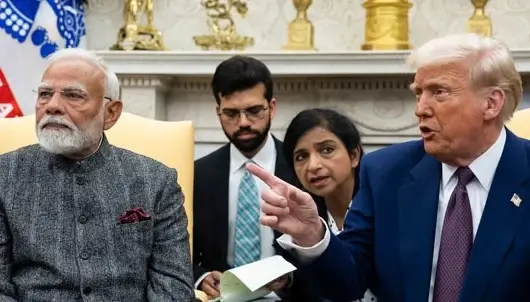
U.S. President Donald Trump announced that the United States is entering into a new trade deal with India. Speaking at a ceremony at the White House, President Trump said the agreement will be “different from those of the past.”
He also reiterated his criticism of India’s purchases of Russian oil, saying that money from those purchases is effectively being used to fund Russia’s war in Ukraine. The president has publicly argued that India’s purchases of discounted Russian crude help finance Moscow’s military operations in Ukraine — a major reason he has pushed for tariffs and other measures to pressure Delhi to reduce its oil imports from Russia.
Trump added that India is gradually ending its oil imports from Russia and hinted at possible tariff reductions, saying, “We may lower tariffs on India at any time.”
President Trump acknowledged that India currently “does not like him very much,” but said he expected relations to warm again soon.
In a related development, President Trump has appointed Sergio Gor as the new U.S. Ambassador to India. Gor has officially taken the oath of office and assumed his duties.
Trump Makes Bold Claim about New York
Background
Since the escalation of the Russia–Ukraine war, the Trump administration has publicly pressured countries buying Russian oil, arguing that revenue from those sales helps fund the war. U.S. officials and aides have explicitly accused India of indirectly financing Moscow’s military campaign by importing Russian crude at discounted prices. As part of that pressure campaign, the White House announced additional tariffs on certain Indian imports citing India’s continued purchases of Russian oil; an official White House action described the imposition of ad valorem duties tied to India’s imports of Russian oil.
Those measures strained U.S.–India trade ties but were framed by the administration as a lever to push for a reduction in Russian oil purchases and ultimately to pressure Moscow toward a negotiated end to the war in Ukraine. Recent statements by President Trump reflect a mix of pressure (tariffs and public criticism) and engagement (talks of a new trade deal and the appointment of an ambassador) aimed at re-shaping bilateral economic relations.