 NewsMakers-Daily Latest Urdu Breaking News Updates We Make Better News
Web Desk
May 18, 2026
TEL AVIV/WASHINGTON – Fears of a renewed full-scale war between the US-Israel alliance and Iran are rapidly maturing as multiple reports confirm that both nations are in the final stages of preparing for military action, potentially as early as this week.
Israeli officials have reportedly assessed the chances of war resuming within days at 50 percen. According to Israeli media outlet Ynet, authorities are preparing for renewed fighting “without any safety margin” in an effort to avoid being caught off guard.
‘Calm Before the Storm’
US President Donald Trump added to the growing alarm by posting an image on his Truth Social platform showing himself aboard a ship in rough seas alongside the phrase: “Calm before the storm”. Trump has also issued fresh warnings to Tehran, stating: “For Iran, the Clock is Ticking, and they better get moving, FAST, or there won’t be anything left of them. TIME IS OF THE ESSENCE!”
Massive US Military Airlift to Israel
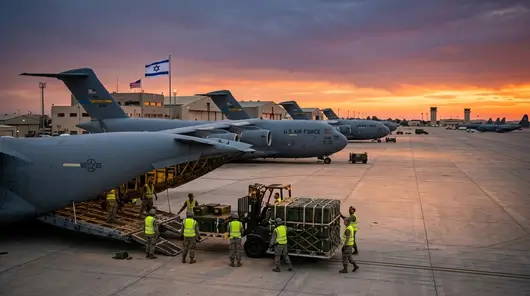
According to Israeli Defence Ministry data, Israel has received more than 115,600 tons of military equipment from the United States since the war began on February 28. Over a single 24-hour period, Israel received 6,500 tons of military equipment, including thousands of ground and air munitions, light armored utility vehicles, and military trucks.
Navigation data from FlightRadar24 and ADS-B Exchange showed at least 30 US military cargo planes departing from Germany towards the Middle East within 48 hours, with seven flights specifically headed to Israel. Israeli media have reported that dozens of US planes carrying ammunition from bases in Germany landed in Tel Aviv on Monday.
Amir Baram, Director-General of Israel’s Ministry of Defence, confirmed that “procurement of arms and military equipment will continue and intensify in the coming weeks”.
US Approves $8.6 Billion in Arms Sales
The United States has also approved military sales worth more than $8.6 billion to key West Asian allies, including Israel, Qatar, Kuwait, and the United Arab Emirates. These approvals come as the conflict entered its ninth week and a fragile ceasefire remains in place.
Pentagon Plans: ‘Sledgehammer’ Operation
US media outlets have reported that the Pentagon has developed two major scenarios for renewed conflict, with an operation reportedly code-named “Sledgehammer”:
| Scenario | Details |
|---|---|
| Aggressive Airstrikes | More intense bombing campaign targeting Iranian military installations and infrastructure |
| Ground Operation | Deployment of special forces to extract enriched uranium buried deep underground |
For a potential ground operation, the US has reportedly gathered approximately 5,000 Marines and 2,000 paratroopers from the elite Air Force division. Trump himself confirmed ongoing preparations, stating: “In military terms, we are about 70-75 percent done. We didn’t finish every single thing. We’ll come back and finish it”.
Another option reportedly being considered includes conquering Iran’s key oil export hub of Kharg Island in the Persian Gulf.
Stalled Nuclear Negotiations
The military buildup comes as diplomatic efforts have completely stalled. Tehran and Washington remain deadlocked over Iran’s nuclear program, control of the Strait of Hormuz, and post-war compensation.
Iran has reportedly laid out a five-point plan demanding:
- Lifting of all sanctions
- Compensation for war damages
- Recognition of Iranian sovereignty over the Strait of Hormuz
- End of military operations across all fronts (including Lebanon)
- Return of frozen overseas assets
The United States has countered with its own five conditions, including:
- Removal of 400 kilograms of enriched uranium from Iran
- Reduction to only one active nuclear facility
- No war compensation
- Most frozen Iranian assets to remain blocked
- End to ballistic missile programs
Iran’s Military Capabilities Partially Restored
Despite US claims of crippling Iran’s military, intelligence suggests Tehran has retained between 30% to 60% of its missile potential. According to NATO sources cited by The Independent, 30 to 33 Iranian missile sites along the Strait of Hormuz have survived US-Israeli strikes and remain capable of threatening global oil supplies.
Iran has also consolidated political forces internally, with experts indicating “practically zero” probability of internal uprisings.
Fragile Ceasefire Crumbling
The ceasefire, brokered through Pakistani mediation in early April, has so far not been able to produce a lasting political agreement. While Trump has extended the truce indefinitely, the underlying issues remain unresolved.
Israeli Defence Minister Israel Katz has warned that Israel may soon have to “act again” against Iran to ensure it “does not once again become a threat to Israel”. A senior Israeli official told Channel 12: “We’re preparing for days to weeks of fighting and waiting for Trump’s final decision. We’ll know more in 24 hours”.
Global Economic Implications
A renewed conflict would inevitably send global oil prices soaring. In April, prices already exceeded $120 per barrel — the highest since 2022. The Strait of Hormuz remains effectively closed, with Iranian and US blockades choking off approximately one-fifth of the world’s oil shipments.
Regional Spillover
The conflict has already spilled into Lebanon, where a separate 45-day ceasefire extension between Israel and Hezbollah was announced — though Israeli strikes continue despite the truce. Lebanon’s Foreign Minister Abdallah Bou Habib has called for an “independent monitoring mechanism” and firm US guarantees.
A Lebanese official told the Saudi Asharq Al-Awsat newspaper that Lebanese officials and US mediators had proposed turning the November 2024 ceasefire agreement into a new formula, but the situation remains highly volatile.
Global Diplomatic Efforts
International mediation efforts continue. Russian President Vladimir Putin discussed the crisis with UAE President Mohammed bin Zayed Al Nahyan on Saturday, with both leaders agreeing on the importance of continuing the “political and diplomatic process”.
China, which hosted Trump for two days of talks earlier this month, has reportedly agreed not to supply military equipment to Iran — giving Washington additional confidence in its military planning.
What Comes Next?
With the US midterm elections approaching in November and Trump facing mounting domestic pressure, analysts suggest the window for a decisive military resolution may be closing — or opening. Prolonged negotiations may push the White House toward one final attempt to resolve the Iranian issue by force.
For now, the region remains on a knife’s edge. As one Israeli official told The New York Times: “The Americans understand that negotiations with Iran are going nowhere”.