 NewsMakers-Daily Latest Urdu Breaking News Updates We Make Better News
Monday, 27 April 2026 | Web Desk
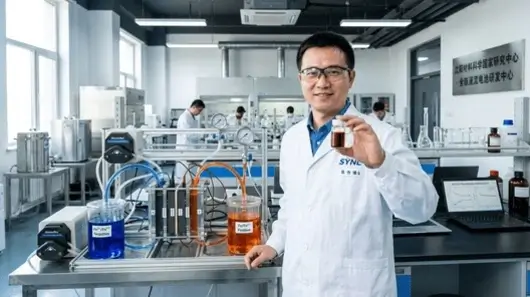
SHENYANG, China – Chinese scientists have achieved a major breakthrough in “all-iron flow battery” technology that could sharply reduce the cost of storing renewable energy while significantly extending battery lifespan. The development addresses one of the most critical bottlenecks in the global transition to clean energy: the need for affordable, long-duration energy storage.
A research team from the Institute of Metal Research under the Chinese Academy of Sciences (CAS) has developed a highly stable electrolyte capable of sustaining thousands of charge-discharge cycles with virtually no capacity loss, according to findings published in the journal Advanced Energy Materials.
Cost Advantage: Iron vs. Lithium
The economic implications of the breakthrough are substantial. Lithium costs over 80 times more than iron as a raw industrial material at present. This dramatic price difference positions iron-based batteries as a potential solution to the high costs that have historically hindered large-scale renewable energy adoption.
Iron is one of the most abundant and inexpensive materials on Earth, making it the ideal foundation for storage systems that need to scale to the gigawatt-hour level without the supply chain risks associated with lithium or vanadium. Case Western Reserve University researchers, who are developing similar technology, note that iron currently sells for less than 25 cents per pound, while vanadium has cost between $8 and $20 per pound.
Technical Breakthrough: 6,000 Cycles Zero Decay
The research team focused on overcoming the fundamental limitations of alkaline all-iron flow batteries (AIFBs), which have traditionally suffered from poor cycling stability due to hydrolysis, disproportionation, and ligand dissociation of active iron species in the negative electrolyte.
Through innovative molecular engineering, the team developed a novel dual-ligand synergistic chelation strategy to stabilize the iron complex anolyte. The new system features:
- High steric hindrance – Large-space molecular structures that prevent unwanted chemical reactions
- Negatively charged protective layer – Creates electrostatic repulsion that shields the active material from decomposition and inhibits crossover through the membrane
The experimental results are remarkable:
| Performance Metric | Result |
|---|---|
| Cycles achieved | Over 6,000 cycles |
| Capacity retention | 100% (zero decay) |
| Average Coulombic efficiency | 99.4% |
| Energy efficiency at 150 mA/cm² | 78.5% |
| High-concentration cycling | 2,000+ cycles without decay, no precipitation or by-products |
The battery demonstrated stable operation at 80 mA/cm² current density with 100% capacity retention throughout 6,000 cycles – a record performance for the field. “It offers a low-cost, long-life solution for large-scale energy storage,” the institute said in a press release on April 16.
How All-Iron Flow Batteries Work
Unlike conventional lithium-ion batteries, flow batteries store energy in liquid electrolytes held in external tanks. The chemical reactants are pumped through a chamber where electrodes convert chemical energy into electrical energy. This design offers fundamental advantages for grid-scale storage:
- Decoupled power and energy – Storage capacity can be increased simply by enlarging the tanks
- Long service life – The electrodes themselves are not consumed during operation
- Enhanced safety – Aqueous electrolytes eliminate fire risk associated with lithium-ion systems
Iron flow batteries utilize reversible rusting as their core chemical mechanism. During discharge, the battery “breathes” oxygen to convert iron into rust; during charging, the rust is transformed back into iron.
Global Race for Iron-Based Storage
The Chinese breakthrough comes amid intensifying global efforts to commercialize iron-based energy storage. Several organizations are racing to bring the technology to market:
ESS Tech Inc. specializes in iron flow batteries, which use a liquid electrolyte composed of iron, salt, and water. The company recently launched a 50 MWh pilot with Salt River Project, marking a significant milestone in validating iron flow technology for utility-scale applications.
Form Energy has pioneered the iron-air battery, achieving 100-hour storage at less than one-tenth the cost of lithium-ion. It has recently moved into full-scale production at its West Virginia facility.
Case Western Reserve University researchers are developing iron-based flow batteries with a target cost of $30 per kilowatt-hour – well below the Department of Energy’s goal of $100/kWh. “We like to call this the rustbelt battery,” said Robert Savinell, professor of chemical engineering at Case Western Reserve, who first proposed an iron-based flow battery 30 years ago.
Addressing the Renewable Energy Bottleneck
The global energy transition faces a critical challenge: storing intermittent power from solar and wind farms at a scale sufficient to stabilize the grid. Solar and wind generators are variable and, unlike fossil-fueled power plants, cannot be turned on or off to meet peak demand.
Traditional lithium-ion batteries, while excellent for short-duration applications (2-4 hours), become prohibitively expensive for storage needs extending beyond eight hours. The U.S. grid would need 225-465 gigawatts of long-duration energy storage (LDES) capacity by 2050, requiring a net investment of $330 billion.
Flow batteries are specifically suited for long-duration applications (8-12+ hours), offering minimal degradation over time. Unlike lithium-ion, iron-based systems carry no risk of thermal runaway or fires, making them significantly easier to permit and install.
Future Outlook
The Chinese team’s work not only demonstrates a breakthrough in performance but also establishes systematic molecular design principles and evaluation methods for iron-based electrolytes, advancing all-iron systems toward higher reliability, longer service life, and lower levelized cost of electricity.
However, commercialization challenges remain. Experts estimate that rebuilding production capacity and scaling manufacturing could take several years. As one analyst noted, while the lab-scale results are impressive, “the real test will be whether this technology can maintain its performance as it scales from the laboratory to the grid.”
Nevertheless, the breakthrough marks a significant step toward solving one of the most persistent challenges in renewable energy: how to keep the lights on when the sun isn’t shining and the wind isn’t blowing – without breaking the bank.
This story will be updated as further details about commercialization timelines become available.