 NewsMakers-Daily Latest Urdu Breaking News Updates We Make Better News
Thursday, 13 November 2025 | Web Desk
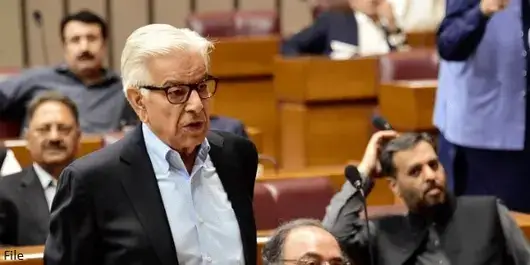
Defence Minister Khawaja Asif has said that Afghanistan’s plan to reduce transit trade with Pakistan will, in fact, prove beneficial for Pakistan.
Tensions between Pakistan and Afghanistan have led to the closure of border crossings since October 11. Following recent clashes along the 2,600-kilometre-long frontier, cross-border trade has come to a complete halt, with long queues of cargo trucks lined up on both sides.
Speaking to Geo News, Khawaja Asif said that if Afghanistan decides to suspend trade with Pakistan, it will have no negative impact on Pakistan.
“It will actually be a relief for us,” he said, “because the goods booked under Afghanistan’s name at Karachi Port ultimately end up in Pakistani markets.”
The minister added that most goods imported from Afghanistan are not consumed there and instead disrupt local markets in Pakistan.
“When their trade traffic decreases here, the terrorism that enters Pakistan under the guise of trade will also decline, and border management will improve for us,” he stated.
Khawaja Asif remarked that the Afghan government’s move could turn out to be a blessing in disguise for Pakistan.
Mullah Baradar Urges Afghan Traders to Seek Alternate Routes
Earlier on Wednesday, Afghanistan’s Deputy Prime Minister for Economic Affairs, Mullah Abdul Ghani Baradar, instructed Afghan traders to look for alternative trade routes instead of relying on Pakistan.
He said all traders should “quickly find alternative routes for exports and imports so that Afghanistan’s trade is not affected.”
According to Mullah Baradar, the decision came in response to Pakistan’s repeated closure of border crossings.
“Until Pakistan provides firm assurances that the borders will not be closed again, the routes will remain shut. If Pakistan wants them reopened, it must give credible guarantees that they will not be closed under any circumstances,” he said.
Pakistani Traders Concerned Over Trade Disruption
Former Senior Vice President of the Sarhad Chamber of Commerce and Industry, Engineer Manzoor Elahi, warned that if Afghanistan stops trade with Pakistan, the loss would be greater for Pakistan.
“Iran and India are already supplying cheaper medicines to Afghanistan, while Uzbekistan and Russia provide them with sugar. They don’t need us — it’s we who need them,” he said. “Our industries will be affected, and Pakistan will lose not only the Afghan market but also the Central Asian market.”
Elahi added that if the situation persists, daily trade worth $100–200 million could be affected.
Vice President of the Pak-Afghan Joint Chamber of Commerce and Industry (PAJCCI), Ziaul Haq Sarhadi, said nearly 8,000 trucks are stranded on both sides of the border since its closure.
Head of the Afghan chapter of PAJCCI, Khan Jan Alokozai, said Afghan traders still prefer doing business through Pakistan, as it remains the shortest route.
“Pakistan and Afghanistan are important for each other, but if the borders remain closed, we will be forced to find alternative routes,” he said.
He warned that Pakistan could lose access to the Central Asian market if the situation continues, adding that Pakistan exports around 300,000 to 500,000 tonnes of potatoes to Central Asia via Afghanistan every season.
The month-long closure of the Torkham border has already caused losses exceeding $45 million, while import and export activities have suffered an additional Rs16.5 billion in damages.