 NewsMakers-Daily Latest Urdu Breaking News Updates We Make Better News
Monday, 02 March 2026 | Web Desk
The ongoing war between Iran and the United States has dramatically reshaped global aviation routes, thrusting the airspace of Pakistan and Afghanistan into the spotlight as the world’s busiest flight corridor.
With the conflict zone encompassing large swathes of Middle Eastern airspace, international carriers are being forced to reroute flights through the only safe alternative—the Pakistan-Afghanistan air corridor—resulting in an unprecedented surge in overflights.
Flight Radar Shows Unprecedented Congestion
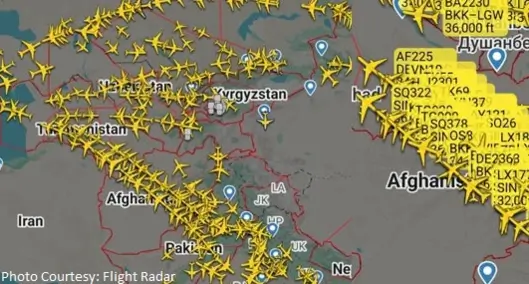
Real-time flight tracking data from Flight Radar reveals extraordinary density in the skies above Pakistan and Afghanistan. Images captured from the tracking service show a thick web of flight paths converging on the region, as aircraft from Europe, China, Southeast Asia, and the Gulf states navigate around the closed Iranian airspace.
The visual data confirms what aviation authorities are now calling the most heavily trafficked air corridor in the world.
Aviation Industry Reaps Millions
According to Geo News, the Pakistan Civil Aviation Authority has reported that the dramatic increase in overflights is expected to generate millions of dollars in revenue for the country’s aviation industry.
Each foreign carrier traversing Pakistani airspace pays significant overflight fees, and with the volume of traffic multiplying overnight, the financial windfall could be substantial. Industry sources suggest the current crisis could net Pakistan tens of millions of dollars in additional revenue if the conflict persists.
Strategic Importance Elevated
The crisis has underscored the strategic importance of Pakistan and Afghanistan, which now serve as the primary aerial bridge between East and West. Airlines that previously flew direct routes over Iran are now taking longer but safer paths over the Pakistan-Afghanistan corridor, adding flight time but ensuring passenger safety.
Regional Airspace Closures
Multiple Gulf countries have either partially or fully closed their airspace due to the conflict:
- Iranian airspace remains effectively closed to most international carriers
- Kuwait, Qatar, and UAE have reported airspace disruptions due to ongoing strikes
- Iraqi airspace is largely inaccessible
This has left the northern route over Pakistan and Afghanistan as the only viable option for flights connecting Europe, the Middle East, and South Asia with East Asia and beyond.
Operational Challenges
While the surge in overflights brings revenue, it also presents operational challenges for Pakistan’s air traffic control systems, which must now manage dramatically increased traffic volumes while maintaining safety standards. Authorities have assured that all necessary measures are in place to handle the additional burden.
The situation remains fluid, with the duration of the conflict determining how long this new aviation geography will persist.