 NewsMakers-Daily Latest Urdu Breaking News Updates We Make Better News
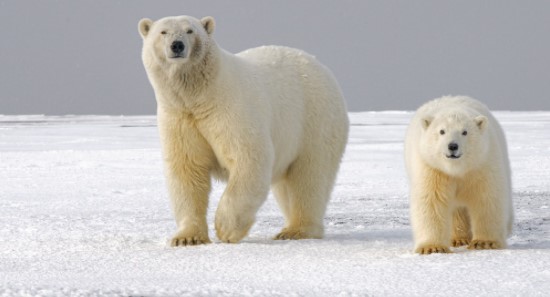
Ice-melting on human relations is indeed a good omen but to say that sea-ice is melting is an alarming situation for both animals and humans but particularly for polar bears.
According to a shocking research done in America polar bears will extinct from earth by the end of this century. Scientists say that the decreasing level of sea ice in the arctic region is bringing polar bears to the brink of extinction.
Polar bears depend on the ice of arctic ocean for search of food but due to the global warming impact polar bears have to take long course or roam about on coasts to feed their cubs.
Various studies on polar bears have shown that the declining amount of ice in the arctic ocean will greatly reduce the number of polar bears. A new study published in Nature Climate Change reveals a timeline of when and how the Hour of Judgment will blast over these beautiful masterpieces.
Dr. Steven C. Amstrup, chief scientist for Polar Bears International, says: “What we have shown is that first we will lose the polar bears cubs. Polar bear mothers will give birth to cubs but there won’t be enough fats in their body to convert into milk for cubs. We all know that we can only go without food for a certain period of time. “This is a biological reality for all creatures.”
Researchers have also predicted that this situation has already arisen in different parts of the Arctic where polar bears live. Dr. Amstrup says that the growing threat to polar bears is, in fact, an alarm bell for humans too as we prepare ourselves for future catastrophes.
According to Dr. Amstup, “The progress we are making now is not enough but if we all come together and work together, we can save the polar bears, and if we do it, we will benefit all living beings on earth including ourselves.”
According to researchs, in an environment, where large amounts of greenhouse gases are destroying the natural environment, we will see large populations of polar bears vanishing soon.
And even if there is reduction in the emission of dangerous gases, the danger to the largest carnivores, the polar bears, does not diminish. Estimates of the current research suggest that pre-existing research suggests that if climate change is not curtailed, only a handful of polar bear populations will survive, far from the North Pole.
Estimates of the current research strengthen finds of earlier researchs that in case climate change is not curtailed, only a handful of polar bear populations will survive and that too far from the North Pole.
Sea ice is frozen seawater that freezes and melts with the formation of the polar seasons and floats on the surface of the ocean. In some Arctic regions these giant icebergs remain intact year after year, providing important natural habitat for wildlife such as polar bears, seals and walrus. It is indeed alarming that sea ice, that remains in the Arctic for more than a year, has been declining at a rate of about 13 percent in a decade.
If we are serioius to reduce the real threats to the natural environment from global warming, we must adhere to the Paris Agreement 2015, which is the key point for elimination of greenhouse gases emissions. Unfortunately former US President Trump left the Paris Accord in 2016 for his own political interests.
There is no doubt that the effects of global warming are international but United States will have to bear the brunt of leaving the Paris Accord.