 NewsMakers-Daily Latest Urdu Breaking News Updates We Make Better News
By Muhammad Zaheer
June 29, 2026
The whole world sees the rising sun, but for Pakistan, even the setting sun is not far from the global view. They say success shines bright. But for us, even our failures are glowing—broadcast across the world for everyone to see.
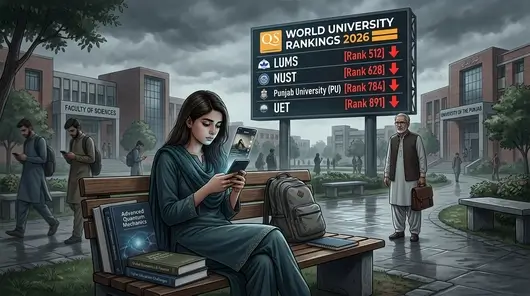
When we look at global university rankings, and see Pakistani institutions tumbling further down the list year after year, one cannot help but wonder: these are the places where our future is being built. If this is their condition, what kind of future are we crafting?
A Grim Picture: No Pakistani University in the Top 350
Not a single Pakistani university has been able to secure a place among the world’s top 350 universities. What is even more alarming is that our institutions have declined further from their already poor positions last year.
Here are a few examples from the latest QS World University Rankings:
| University | 2025 Ranking | 2026 Ranking | Change |
|---|---|---|---|
| Quaid-e-Azam University, Islamabad | 354 | 381 | ▼ 27 |
| NUST (Islamabad) | 371 | 384 | ▼ 13 |
| University of the Punjab, Lahore | 542 | 588 | ▼ 46 |
| LUMS, Lahore | 555 | 608 | ▼ 53 |
| Agriculture University, Faisalabad | 654 | 629 | ▲ 25 |
| UET, Lahore | – | 791 | – |
| Aga Khan University, Karachi | – | 951 | – |
| Bahauddin Zakariya University, Multan | – | 1001+ | – |
| University of Lahore | – | 1001+ | – |
Only one university showed a slight improvement, while the rest continued their downward slide.
The Problem Is Not Infrastructure—It’s Quality
The decline is not because students aren’t getting good food, or because buildings are old, or because classrooms lack air conditioning. Pakistani universities often have excellent infrastructure and modern facilities.
The real problem is academic quality. The standard of teaching, research, and intellectual rigor is falling—and falling fast. That is why our global rankings are not improving; they are deteriorating every single year.
A Visit to a Private University in Lahore
Some time ago, I visited a private university in Lahore. I asked a student: “What’s special about this place?” He replied with a straight face:
“The students here are experts at making TikTok videos.”
That one sentence summed up everything.
Education Is Being Treated Like a Business
In Pakistan, the government treats education like a neglected stepchild, while the private sector treats it like a cash cow—printing degrees and minting money without any accountability for quality.
If you look at the pass percentage in the CSS (Central Superior Services) exam —Pakistan’s top competitive examination—you will quickly understand the state of our academic standards. The fact that thousands of unqualified candidates still manage to pass is a testament to how low the bar has been set.
What Are We Researching?
Most MPhil and PhD degrees in Pakistan are awarded in:
- Urdu
- Punjabi
- Mass Communication
- Political Science
Meanwhile, advanced degrees in Chemistry, Physics, Mathematics, and English Literature are practically non-existent. We are producing graduates in fields that offer little intellectual or economic value, while the sciences and humanities—the real engines of progress—are being ignored.
A Simple Calculation
Let us put things in perspective:
MIT (Massachusetts Institute of Technology) is ranked #1 in the world.
LUMS is ranked #608.
Even if LUMS improved by one rank every single year, it would take over 600 years to reach MIT’s position.
That is not a gap. That is a chasm.
The Media Was the Last Hope—Now It’s Sinking
There was a time when Pakistani media played the role of a “God’s soldier”—critiquing, questioning, and holding the powerful accountable. But even that ship is now sinking. The media has become part of the problem, not the solution.
A Teacher’s Words That Still Echo
A teacher of mine once said:
“For an ordinary person, the best and easiest path to progress is education. But when that education becomes substandard, even a degree is useless—you can’t take it anywhere.”
We are choosing not to improve. And because we choose not to improve, we are getting worse.
A Call for Change
We cannot blame anyone but ourselves. We have allowed mediocrity to become the norm. We have turned our universities into degree-printing factories rather than centers of learning.
If we want to change our future, we must first change the quality of our education. That means:
- Prioritizing research and innovation
- Encouraging critical thinking over rote memorization
- Holding institutions accountable for academic standards
- Investing in science, technology, and the humanities
Until we do, we will continue to watch our universities—and our future—slide further into obscurity.